
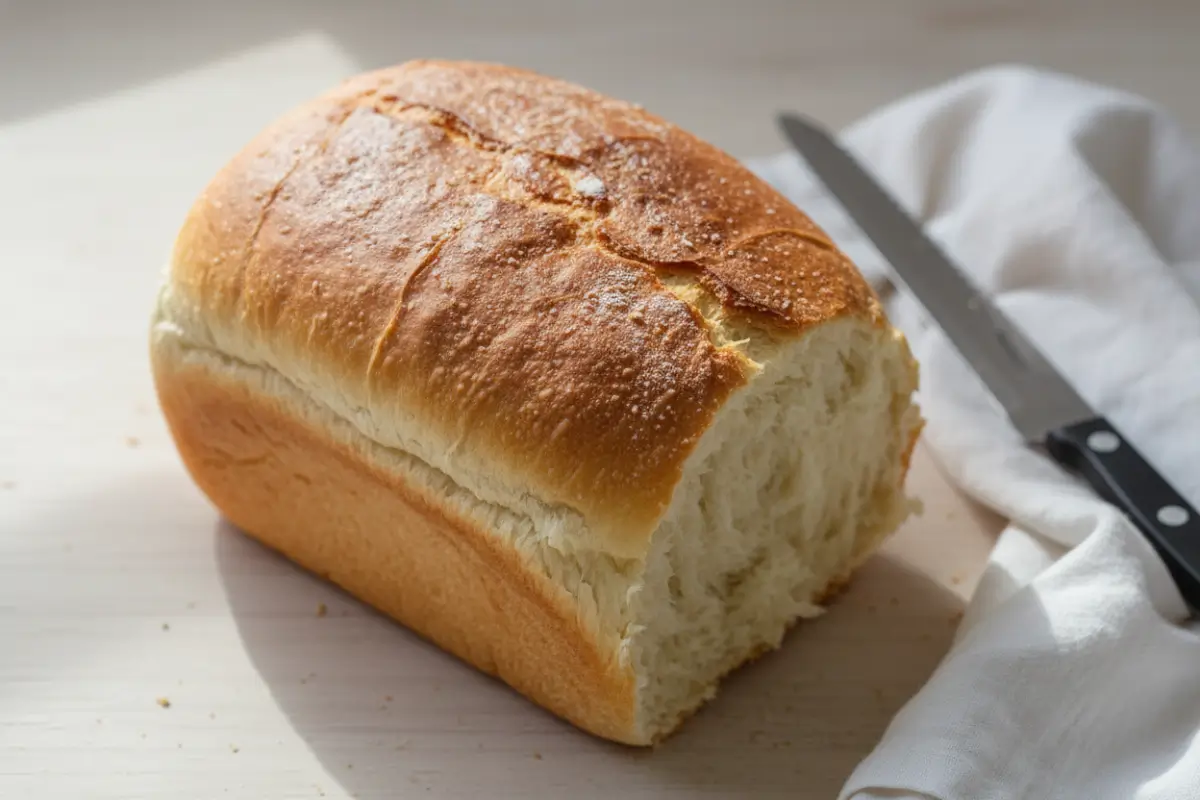
That first pull when the loaf is barely cool enough to touch. Steam rises. The interior stretches like mozzarella but tastes like clouds soaked in butter. This Easy Milk Bread Loaf isn’t your grandmother’s sandwich bread—it’s the Japanese-style shokupan that’s taken over bakeries from Tokyo to Brooklyn, and you’re about to make it in your own kitchen with ingredients you already have.
I tested this recipe seven times in my Asheville kitchen before getting it right. The breakthrough? Cold liquids and that weird double-rest technique that seems fussy but actually saves your arms from kneading forever. My first attempt looked perfect but tasted like cardboard. The sixth version rose beautifully then collapsed like a soufflé. Version seven? Absolute perfection. Golden crust that crackles when you press it. Interior so tender it barely needs teeth.
The secret isn’t exotic ingredients or professional equipment. It’s understanding why milk bread behaves differently than regular bread. The milk proteins create that signature bounce. The sugar feeds the yeast but also keeps the crumb moist for days. And that autolyse rest—the 30-minute pause after initial mixing—lets the flour hydrate fully so you need less aggressive kneading. Your stand mixer will thank you.
This Easy Milk Bread Loaf makes the fluffiest French toast you’ve ever experienced. Toasts to golden perfection. Holds up to the wettest sandwich fillings without getting soggy. And here’s the thing nobody tells you: it actually tastes better on day two. The flavors meld. The texture somehow gets even softer.
Why Most People Fail This Recipe
Problem one: Dense, heavy bread that doesn’t rise properly. You used warm liquids because every bread recipe says “warm water activates yeast.” Wrong. Cold liquids slow the fermentation during mixing, giving you better gluten development before the yeast goes wild. The dough will feel stiffer initially but trust it. When that first rise happens in the warm spot, you’ll get better structure and more dramatic lift.
Problem two: The windowpane test fails and you panic-knead for twenty minutes. Stop. That autolyse rest does half your work. After 30 minutes of rest, the flour has absorbed the liquid completely. The gluten strands have started forming on their own. When you add the butter and resume kneading, you only need 7-8 minutes total. I’ve watched people knead for 25 minutes and end up with tough, overworked dough that bakes into hockey pucks.
Problem three: Butter added too early makes everything greasy and the dough never comes together. This haunted my first three attempts. Butter coats flour particles and prevents gluten formation. You need that initial dough structure FIRST, then the butter can incorporate without interfering. Cut it into cubes. Let it soften slightly at room temperature during the autolyse. When you add it, the dough will look broken for a minute. Keep going. It comes together suddenly and beautifully.
The fix for all three? Follow the temperature and timing guidelines exactly the first time. Really. Once you’ve made it successfully once, then experiment. But this recipe has a logic to its madness that only makes sense after you see the result.
Why You’ll Love This Recipe
- Stays soft for 5 days while store-bought bread turns to sawdust by day three
- No mixer arm workout required because the autolyse rest does the heavy lifting
- Foolproof rise indicators so you’re not guessing if it’s “doubled” or not
- Makes the best toast with a crispy exterior that shatters and a center that stays pillowy
- Freezes beautifully for up to 3 months without any texture loss
Key Ingredients & Why They Matter
Bread flour (500g): The high protein content—usually 12-14%—creates strong gluten networks that trap all those air bubbles. All-purpose flour works in a pinch but you’ll get a slightly denser crumb. I’ve tested both. The bread flour version has that signature pull-apart quality that makes milk bread special. Don’t pack the flour into your measuring cup. Spoon it in lightly or better yet, use a kitchen scale.
Sugar (40g): This isn’t just sweetness. Sugar feeds the yeast for a robust rise. It also attracts and holds moisture, which is why this bread stays soft days later while regular bread goes stale. The Maillard reaction between sugar and proteins creates that gorgeous golden-brown crust. Use regular granulated sugar. Honey or maple syrup change the hydration ratio and you’ll need to adjust the liquid amounts.
Instant yeast (1½ teaspoons): Also called rapid-rise or bread machine yeast. The granules are finer than active dry yeast and don’t need blooming in warm water first. You can substitute active dry yeast in equal amounts but proof it in a few tablespoons of your measured water with a pinch of sugar for 5 minutes first. The cold liquid method works specifically with instant yeast’s resilience.
Cold water and cold milk (225g + 115g): Here’s where most recipes mislead you. Cold liquids keep the dough temperature controlled during the vigorous stand mixer action. Friction from kneading generates heat. If you start with warm liquids, your dough can overheat and the yeast goes into overdrive before gluten develops properly. The result? Weak structure that can’t support the rise. Straight from the fridge is perfect.
Sea salt (9g): Added AFTER the autolyse rest because salt tightens gluten and slows yeast activity. We want the flour to hydrate and gluten to start forming freely first. Then salt strengthens those gluten bonds without inhibiting them. It also controls yeast fermentation so your dough doesn’t overproof. Fine sea salt or table salt works. Kosher salt is less dense so you’d need about 2 teaspoons.
Unsalted butter (25g plus extra): European-style butter with higher fat content makes an even richer loaf but regular unsalted butter works beautifully. The butter added to the dough creates that tender, cake-like crumb. The butter brushed on top after baking gives you that bakery-style glossy finish and adds another layer of flavor. Salted butter throws off the salt balance in the recipe.
Step-by-Step Instructions
Start with cold. Pull your milk and water from the fridge. Measure your bread flour by spooning it into measuring cups or weighing it—500 grams exactly. Add the sugar and instant yeast to your stand mixer bowl. Pour in that cold water and milk. Attach the dough hook and mix on low speed. The dough will look shaggy and rough. That’s correct. After about 3 minutes, it should form a cohesive mass that clears the sides of the bowl. It won’t be smooth yet.
The magic pause. Stop the mixer. Cover the bowl with a damp towel or plastic wrap. Set a timer for exactly 30 minutes. Walk away. During this time, the flour is absorbing every drop of liquid. Gluten strands are forming without any mechanical action. It’s called autolyse and it’s the secret professional bakers use. Meanwhile, take your butter out of the fridge. Cut it into 4 equal pieces. Leave them on the counter. They should soften slightly but not melt into puddles.
Salt and butter time. After 30 minutes, the dough will look smoother and more elastic already. Sprinkle the salt over the surface. Knead on low speed for 1 minute to incorporate it fully. Now add those butter pieces one at a time. The dough will look like it’s breaking apart. It’s not. Keep the mixer running on low speed. After about 6 minutes, the butter will be fully incorporated and the dough will be smooth and slightly tacky. Increase to medium speed for 1 minute.
Windowpane check. Pinch off a golf-ball-sized piece of dough. Gently stretch it between your fingers. If you can stretch it thin enough to see light through it without it tearing, you’re done. If it tears immediately, knead another 2 minutes and test again. You’re looking for that translucent membrane. When I first made this, I under-kneaded and the bread was dense. The windowpane test doesn’t lie.
First rise. Form the dough into a smooth ball by pulling the edges under and pinching them at the bottom. Place it in a lightly greased bowl. Cover tightly with plastic wrap or a damp towel. Find your warm spot—I use my oven with just the light on, which maintains about 85°F. Let it rise for 1 hour. It should nearly double in size. Poke it with a floured finger. If the indentation springs back slowly, it’s ready.
Shape phase one. Turn the dough out onto your counter. Don’t flour the surface—you want a tiny bit of grip. Cut—don’t tear—the dough into 3 equal pieces using a bench scraper or sharp knife. Form each piece into a smooth ball by cupping your hand over it and moving in circles. Cover with a damp towel. Rest 15 minutes. This relaxes the gluten so the next shaping is easier.
The roll-and-rest technique. Take one ball. Pat it into a rough rectangle with your hands. Use a rolling pin to roll it into an oval about 8 inches long. Roll it up from the short end like a jelly roll. Not too tight. Set it aside seam-side down. Repeat with the other two pieces. Cover all three. Rest another 15 minutes. This double-shaping creates those beautiful interior swirls and a tighter crumb structure.
Final shaping. Now here’s the trick. Rotate each log 90 degrees so the seam is facing you horizontally. Roll each one out into a long rectangle about 10 inches long and 6 inches wide. Roll up tightly from the short end again. You’ll have three fat spirals. Grease your 10×5 loaf pan generously with butter. Dust it with flour and tap out the excess. Place the three spirals seam-side down in the pan. They should fit snugly.
The final rise. Cover with greased plastic wrap. Back to your warm spot. This rise takes 1 to 1.5 hours. You’re watching for the dough to fill 80-90% of the pan. The center should dome slightly above the rim. Don’t let it overproof or it’ll collapse in the oven. I set a timer for 45 minutes and check every 15 minutes after that.
Bake with precision. Preheat your oven to 375°F with the rack positioned in the lower third. When the dough is ready, uncover it gently. Slide it into the oven. After exactly 15 minutes, loosely tent a piece of foil over the top to prevent over-browning. Bake another 15-20 minutes until the internal temperature hits 190°F or the loaf sounds hollow when tapped.
The drop technique. Pull the pan from the oven. Immediately lift it about 2 inches above your counter and drop it. Once. This releases steam and prevents the loaf from shrinking as it cools. Turn the bread out onto a cooling rack right away. Brush the top generously with melted butter while it’s still hot. The butter will soak in slightly and create that glossy finish. Let it cool for at least 15 minutes before slicing. I know it’s torture.
Expert Tips & Common Mistakes
Mistake: Slicing the bread while it’s still hot. The interior is still setting. Cut too early and you’ll compress the crumb into dense layers. Fix: Wait at least 15 minutes. Ideally 30 minutes. Use a serrated knife with a gentle sawing motion.
Mistake: Using a pan that’s too large or too small. A 9×5 pan makes a flatter loaf. An 8×4 pan causes overflow. Fix: The 10×5 pan is actually not standard but it’s the Japanese pullman loaf size. If you only have 9×5, reduce all ingredients by 15% or make dinner rolls with the extra dough.
Mistake: Opening the oven door repeatedly to check on the bread. Temperature drops every time you peek. The bread can collapse. Fix: Don’t open the door until that 15-minute mark when you add the foil tent. Use your oven light and look through the window.
Mistake: Storing the bread in the refrigerator. Cold temperatures recrystallize the starches and make bread stale faster. Fix: Keep it at room temperature in a plastic bag or bread box for up to 5 days. For longer storage, slice and freeze in a freezer bag for up to 3 months.
Storage & Reheating
Room temperature storage is best. Once the loaf is completely cool—wait at least 2 hours—wrap it in plastic wrap or store in a bread bag. It stays soft for 5 days on the counter. Don’t refrigerate unless you live somewhere extremely humid.
For freezing, slice the entire loaf first. Layer parchment paper between slices if you want to grab individual pieces. Store in a freezer bag with all the air pressed out. Frozen slices toast directly from frozen—no thawing needed. They’ll taste bakery-fresh even after 3 months.
Reheating a whole loaf? Wrap it in foil and warm at 300°F for 10 minutes. For individual slices, the toaster is your friend. The slightly stale texture actually makes better toast because it absorbs butter without getting soggy.
Perfect Pairings
This bread makes obscene French toast. The tight crumb soaks up custard without falling apart. Try it with strawberry jam and cultured butter for breakfast. It’s substantial enough for thick-cut deli sandwiches but soft enough for kids’ PB&J.
My favorite use? Slice it thick, toast it dark, spread it with salted butter and honey. The contrast between the crispy exterior and cotton-soft interior is everything. It also makes surprisingly good bread pudding because it holds its structure in custard.
Variations & Substitutions
Whole wheat version: Replace up to 100g of the bread flour with whole wheat flour. Add 1-2 tablespoons extra water because whole wheat absorbs more liquid. The loaf will be slightly denser but more nutritious with a nutty flavor.
Tangzhong method: Make a roux with 25g bread flour and 125g water. Cook until it reaches 149°F and forms a thick paste. Cool completely. Add it to the initial mixing stage and reduce the cold water to 100g. This creates an even softer, more pillowy texture that stays fresh for a week.
Dairy-free adaptation: Swap the milk for equal amounts of oat milk or soy milk. Use vegan butter or coconut oil instead of dairy butter. The texture won’t be quite as rich but it’s still excellent. Avoid almond milk—it’s too thin.
Cinnamon swirl loaf: After the final rolling in step 8, brush each rectangle with melted butter and sprinkle with cinnamon sugar (3 tablespoons sugar mixed with 1 tablespoon cinnamon). Roll up and proceed as directed. The swirls look gorgeous when sliced.
FAQ
Can I make this without a stand mixer?
Yes, but it requires serious arm strength. After the autolyse rest, knead by hand on a clean counter for 15-20 minutes until the windowpane test passes. The dough will be sticky initially. Resist adding extra flour. Use a slap-and-fold technique: lift the dough, slap it down, fold it over itself. Repeat until smooth and elastic. Add the butter gradually, kneading it in completely before adding more. Your forearms will burn but the result is worth it.
Why did my bread collapse after baking?
Three likely causes. First, overproofing—if the final rise goes too long, the gluten structure weakens and can’t support itself in the oven heat. Second, underbaking—if the interior doesn’t fully set, it collapses under its own weight as it cools. Use an instant-read thermometer and don’t pull it until it hits 190°F internally. Third, not dropping the pan after baking—that trapped steam can cause shrinkage. The drop releases it immediately.
Can I add mix-ins like raisins or chocolate chips?
Absolutely. Add up to 1 cup of mix-ins during the last minute of kneading after the butter is fully incorporated. Dried fruit, chocolate chips, nuts, or even savory additions like cheese and herbs work beautifully. Just don’t exceed 1 cup or the dough structure becomes compromised. Toss the mix-ins in a little flour first so they don’t clump together.
💡 Loved this recipe? Follow Us on Pinterest for more!
Conclusion
This Easy Milk Bread Loaf transforms your kitchen into a Japanese bakery. The process seems long but most of it is hands-off waiting. Your actual work time? Maybe 20 minutes total. The rest is the dough doing its thing while you live your life.
That first slice while it’s still barely warm. The way it tears instead of cuts. How it makes every sandwich taste expensive and every piece of toast taste like dessert. Make it once and you’ll understand why people get obsessed with baking their own bread. This isn’t a recipe you make once and forget. It’s the one you’ll make every week once you taste the difference.
Easy Milk Bread Loaf – Perfect Homemade Bread Recipe
Ingredients
Equipment
Method
- Start with cold ingredients: milk and water from the fridge.
- Mix the bread flour, sugar, and instant yeast in the stand mixer.
- Add cold water and milk, using a dough hook to mix for 3 minutes.
- Cover and let the mixture rest for 30 minutes (autolyse).
- After resting, add salt and knead for 1 minute.
- Add softened butter piece by piece, mixing until fully incorporated.
- Perform the windowpane check to see if the dough is ready.
- Form the dough into a ball and place it in a greased bowl to rise for 1 hour.
- Divide the dough into three equal pieces and shape each into a ball.
- Flatten each ball, roll it into an oval, then roll it up into a log.
- Place the logs into a greased loaf pan and cover for the final rise.
- Bake in a preheated oven at 375°F, covering with foil after 15 minutes.
- Drop the loaf pan from a height of 2 inches to release steam after baking.
