
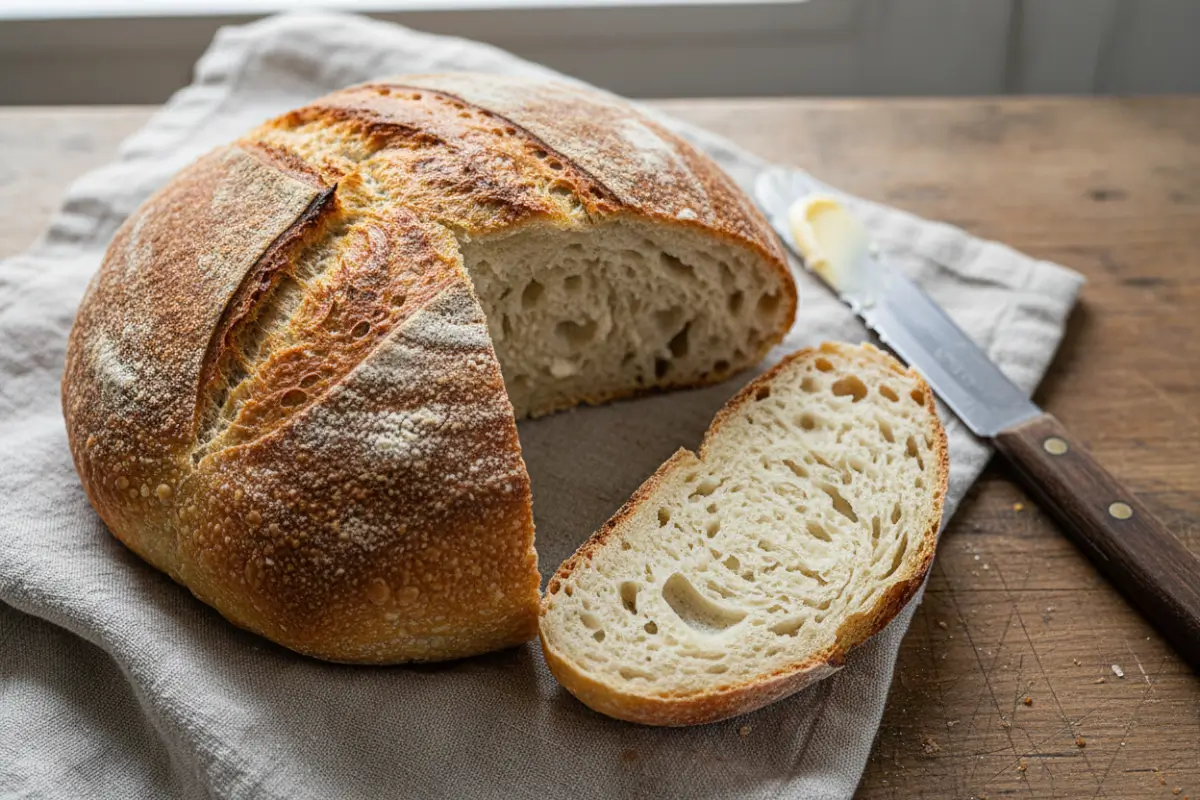
You don’t need a PhD in fermentation to bake gorgeous sourdough. This quick easy beginner sourdough bread recipe strips away the fuss—no fancy equipment, no cryptic baker’s math, just a warm kitchen and your hands. I developed this method in my Asheville kitchen after watching too many friends give up on sourdough because “it’s too complicated.” It’s not. The dough does most of the work while you sleep or binge your favorite show. You’ll mix everything in one bowl, let time work its magic, then pull a crackling, golden loaf from your Dutch oven. The crust shatters. The inside? Soft, airy, tangy. And you made it happen with nine ingredients and zero stress.
Prep: 35 mins | Cook: 1 hr | Total: 14 hrs | Yields: 1 loaf
Why You’ll Love This
- Actually beginner-friendly: No kneading machine, no special tools beyond a Dutch oven
- Flexible timing: Bulk rise adapts to your schedule—3 hours in summer, overnight in winter
- Forgiving dough: Choose your water amount based on confidence level (less water = easier handling)
- One-bowl simplicity: Less cleanup, more bread eating
Key Ingredients
Bubbly, active sourdough starter (150g): This is your leavening agent. “Active” means it doubled within 4-6 hours of feeding and smells pleasantly tangy, not like nail polish remover. If your starter passes the float test (a spoonful bobs in water), you’re golden.
Warm water (250g, up to 325g): Temperature matters—aim for 90-95°F. Too hot kills the starter; too cold slows everything down. Start with 250g for a stiff, manageable dough. Once you’re comfortable, increase to 300-325g for those Instagram-worthy open crumbs and softer texture.
Olive oil (25g): Adds subtle richness and keeps the crumb tender. Not traditional, but this quick easy beginner sourdough bread recipe prioritizes ease over purist rules.
Bread flour (500g): The protein content (12-14%) creates structure. All-purpose won’t cut it here—you need that gluten strength for rise and chew. King Arthur, Gold Medal, and Pillsbury all tested beautifully.
Fine sea salt (10g): Controls fermentation, strengthens gluten, makes everything taste like bread instead of bland dough. Don’t skip it.
Cornmeal or parchment paper: Prevents sticking during the second rise. Parchment is foolproof—I use it every time now.
Dutch oven (5.5-6 quart): Traps steam to create that bakery crust. Cast iron or enameled both work. No Dutch oven? This recipe won’t work the same way.
Instructions
Mix the shaggy dough: Dump your bubbly starter, warm water, and olive oil into a large bowl. Whisk with a fork until the starter breaks up—it’ll look cloudy and frothy. Add all the bread flour and salt at once. Stir with your fork until the mixture gets too stiff to move, then dive in with your hands. Squish and squeeze until no dry flour pockets remain. The dough will look rough, dry, even a little angry. That’s perfect.
Autolyse rest (30-60 minutes): Cover your bowl with plastic wrap or a damp towel. Walk away. During this rest, flour absorbs water and gluten starts organizing itself without any effort from you. This step makes the dough easier to work with later. Really.
Form a rough ball: After resting, the dough will feel more cohesive. Use your hands to gather the edges and fold them toward the center a few times, rotating as you go. Takes about 15 seconds. You’re not looking for smooth—just a general ball shape. If you used 250g water, it’ll feel firm and tight. With 300g+, it’ll be softer and stickier. Both are correct.
Bulk rise (3-12 hours): Cover the bowl again and set it somewhere warmish—70-75°F is ideal. Now you wait. This is where beginners panic, but here’s the truth: watch the dough, not the clock. It’s ready when it looks puffy, jiggly, and almost doubled. In my summer kitchen, this takes 3-4 hours. In January? Closer to 10-12 hours overnight. Your starter strength and room temp control everything.
Optional stretch and folds: About 30-45 minutes into bulk rise, you can strengthen the dough. Wet your hand, grab one section of dough, stretch it up about 8 inches, then fold it over itself. Rotate the bowl a quarter turn and repeat until you’ve gone full circle. That’s one set. Do this once or twice, spaced an hour apart. It improves rise and structure, but if you forget, your bread will still be delicious.
Shape on a floured surface: When bulk rise finishes, turn the dough onto a lightly floured counter. Don’t punch it down—let it gently deflate as you work. Starting at the top edge, fold the dough toward the middle. Give the whole mass a quarter turn, fold again. Keep rotating and folding until you’ve come full circle. Flip it seam-side down.
Create surface tension: Cup your hands around the dough and rotate it in quick quarter-turns against the counter. The bottom should catch slightly on the unfloured surface—that friction tightens the skin. If it’s sliding around, brush away excess flour. Do this for 30 seconds until the top looks smooth and taut.
Second rise in the Dutch oven (30-60 minutes): If you used 250g water, sprinkle cornmeal (or lay parchment) in your Dutch oven and place the shaped dough inside. Cover with the lid. Let it rise until slightly puffy—not doubled, just relaxed and a bit bigger. If you used more water, skip this and use a floured proofing basket instead; wetter dough spreads in the pot.
Preheat during the tail end: About 20 minutes before the second rise finishes, crank your oven to 450°F. You want it screaming hot when the bread goes in.
Score the top: Right before baking, use a sharp knife, razor blade, or bread lame to make one confident slash down the center, about 2-3 inches long and ¼-inch deep. This controls where the bread expands. Hesitate and you’ll get a jagged cut—just commit.
Bake covered (20 minutes): Slide the Dutch oven into the center rack, lid on. Immediately reduce temp to 400°F. The lid traps steam, which keeps the crust soft enough to expand before it hardens.
Bake uncovered (40 minutes): Remove the lid. The bread will be pale and puffy. Keep baking until the crust turns deep mahogany—don’t be shy. Underbaked sourdough tastes gummy. If you have an instant-read thermometer, the center should hit 205-210°F.
Cool completely: Transfer to a wire rack. Wait at least an hour. I know it smells insane, but cutting warm bread turns the crumb gummy and damp. Patience pays off.
Tips & Variations
Adjust water for confidence: New to this quick easy beginner sourdough bread recipe? Stick with 250g water. The dough handles like Play-Doh. Once you’ve baked it twice, bump to 300g for airier crumb.
Room temp matters more than time: In Asheville’s humid summers, I set my bowl near (not on) a sunny windowsill. Winter? Inside the oven with the light on creates a cozy 75°F environment.
Stretch and folds aren’t mandatory: Skipping them gives you slightly denser bread, but it’s still miles better than store-bought. Do them when you remember.
Add-ins: Fold in ½ cup chopped rosemary and olives after the autolyse rest. Or swirl in cinnamon and raisins for breakfast loaves.
Whole wheat version: Swap 100g bread flour for whole wheat. Add an extra 25g water since whole grains drink more liquid.
Storage & Pairings
Store at room temperature in a bread bag or wrapped in a kitchen towel for 3 days. Slice and freeze for up to 3 months—toast straight from frozen. Serve with salted butter and flaky sea salt, dip in olive oil and balsamic, or use for next-level grilled cheese. The tangy crust pairs beautifully with sharp cheddar and tomato soup.
FAQ
Can I use all-purpose flour instead of bread flour?
No. All-purpose lacks the protein needed for structure. Your loaf will be dense and flat. Bread flour is non-negotiable here—the 12-14% protein creates the gluten network that traps air and gives you that chewy, open crumb.
Why didn’t my bread rise?
Three common culprits: weak starter (it should double enthusiastically after feeding), cold environment (below 68°F slows everything to a crawl), or not enough bulk rise time. Give it more time. Seriously. Sourdough is patient; you should be too.
💡 Loved this recipe? Follow Us on Pinterest for more!
Conclusion
This quick easy beginner sourdough bread recipe proves you don’t need a bakery pedigree to make stunning bread. Mix, wait, shape, bake. That’s it. Your kitchen will smell like a French boulangerie, and you’ll have a loaf that makes people ask for the recipe. Now go—your starter is bubbling.
Quick Easy Beginner Sourdough Bread Recipe
Ingredients
Equipment
Method
- Dump your bubbly starter, warm water, and olive oil into a large bowl and whisk until the mixture is cloudy.
- Add all the bread flour and salt at once and mix until too stiff to move, then use your hands to combine.
- Cover the bowl with plastic wrap and let the dough autolyse for 30-60 minutes.
- After resting, gather the dough edges to the center to form a rough ball.
- Cover and let the dough rise until puffy, about 3-12 hours depending on temperature.
- Shape the dough on a floured surface and create surface tension by cupping your hands around it.
- Let it rise in the Dutch oven lined with cornmeal or parchment for 30-60 minutes.
- Preheat your oven to 450°F about 20 minutes before baking.
- Score the top of the dough with a sharp blade before baking.
- Bake covered for 20 minutes, then uncovered for 40 minutes until deeply browned.
- Cool completely on a wire rack before slicing.
