
You know that moment when a recipe calls for breadcrumbs and you’re staring at a half-loaf of stale bread, wondering if you really need to run to the store? You don’t. Those crusty ends and forgotten slices are about to become something actually useful—crispy, golden, infinitely better than anything from a canister. This is the kind of reliable kitchen win that makes you feel capable, the no-fail homemade bread crumbs easy method that turns pantry odds and ends into the crunchiest topping for mac and cheese, the perfect binder for meatballs, or that satisfying coating on chicken cutlets. Fifteen minutes, one pan, and you’ve got breadcrumbs that taste like actual bread instead of sawdust. The smell alone—toasted, buttery, touched with herbs—will make you wonder why you ever bought the store stuff. In my Asheville kitchen, I keep a jar of these on the counter because they disappear faster than I expect.
Why You’ll Love This
Works every single time. No special equipment beyond a food processor or blender. Stale bread becomes treasure.
Tastes like real food. Golden, crispy, with actual flavor—not that flat, dusty texture from a can.
Endlessly adaptable. Plain for binding, herbed for topping, as mild or bold as you need.
Uses what you have. That forgotten baguette, the heels nobody wants, even slightly stale sandwich bread. All fair game.
Key Ingredients
Bread (2-3 cups cubed, about 2 ounces)
Any bread works. Really. Sourdough adds tang. White sandwich bread stays neutral. Whole wheat brings nuttiness. Day-old or slightly stale is actually ideal—it crumbles cleanly without turning gummy. Fresh bread can work if you toast it lightly first, but stale is your friend here. Cut away any truly hard crusts if you want fine crumbs, but leaving them adds texture and color. The cubes should be roughly one-inch—small enough that your processor doesn’t labor.
Olive oil or melted butter (2 tablespoons)
This is what makes them golden instead of pale and sad. Olive oil gives a subtle fruity note and crisps beautifully. Butter adds richness and that irresistible toasted smell. Use what you have. If you’re making plain crumbs for storage, you can skip this and add fat later when you use them. But for immediate toasted crumbs, this step is non-negotiable.
Fine sea salt (1/4 teaspoon)
Seasons from within. Fine salt distributes evenly across all those tiny surfaces. Table salt works too. Don’t skip it—unseasoned breadcrumbs taste like cardboard.
Fresh ground black pepper (1/4 teaspoon)
Adds a gentle warmth without screaming “pepper.” Freshly ground makes a difference here. Those little flecks look good too.
Italian seasoning or dried herbs (2-3 teaspoons, optional)
This is where you make them yours. Italian seasoning is the reliable choice—basil, oregano, thyme all playing together. But you could use just oregano for Greek dishes, thyme for French, or even a pinch of smoked paprika for Spanish flavors. Dried herbs bloom in the hot oil and perfume everything. Fresh herbs burn, so stick with dried here.
Instructions
Cut the bread into small pieces.
Grab your bread and a serrated knife. Cut into roughly one-inch cubes. Smaller is easier on your food processor and gives you more control over the final texture. Toss them in a bowl. If your bread is fresh, spread the cubes on a baking sheet and leave them out for an hour, or toast lightly at 250°F for 5 minutes to dry them slightly. This prevents gummy clumps.
Pulse into breadcrumbs.
Drop the bread cubes into your food processor. Pulse in short bursts—three or four pulses to start. Check the texture. For coarse crumbs (great for topping casseroles), stop when they’re pebble-sized. For fine crumbs (perfect for breading), keep pulsing until they look like coarse sand. Don’t run the processor continuously or you’ll get powder in some spots and chunks in others. Pulse, check, pulse again. Takes maybe 30 seconds total. No food processor? A blender works if you work in small batches and shake it between pulses. A rolling pin and zip-top bag is the old-school method—therapeutic and effective.
Toast in a skillet (stovetop method).
Heat a wide skillet over medium heat. Add your breadcrumbs, olive oil, salt, pepper, and herbs if using. Stir immediately to coat everything. The crumbs should sizzle gently, not violently. Stir constantly with a wooden spoon or spatula. They’ll start pale, then turn golden at the edges. Keep stirring. After about 3 minutes, you’ll smell that toasted bread smell. By 5 minutes, they should be evenly golden and crispy. Taste one—it should crunch audibly. If they’re browning too fast, lower the heat. If nothing’s happening after 3 minutes, raise it slightly. Pour them onto a plate to stop the cooking. They’ll crisp more as they cool.
Or toast in the oven (oven method).
Heat your oven to 300°F. In a bowl, toss the breadcrumbs with olive oil, salt, pepper, and herbs until evenly coated. Spread them on a rimmed baking sheet in a single layer—crowding makes them steam instead of crisp. Slide into the oven. Set a timer for 5 minutes. When it beeps, pull the pan out and stir everything around, bringing the edges to the center. Return to the oven for another 3-5 minutes. Watch closely now. They’ll go from perfect to burnt in 60 seconds. You want deep gold, not brown. When they look right, pull them out. They’ll continue crisping as they cool on the pan.
Tips & Variations
Make them in bulk. Triple this recipe and store plain, untoasted crumbs in a jar. They’ll keep for weeks and you can toast portions as needed with whatever seasonings match your meal.
Freeze for months. Plain breadcrumbs freeze beautifully in a freezer bag. No need to thaw—use them straight from frozen for breading or topping.
Try panko-style. Pulse very briefly for large, irregular flakes instead of fine crumbs. These stay extra crunchy on baked dishes.
Go gluten-free. Use gluten-free bread. The method is identical.
Add parmesan. Toss in 2 tablespoons grated parmesan during the last minute of toasting for Italian-style crumbs that are dangerously good on pasta.
Storage & Pairings
Store cooled breadcrumbs in an airtight jar at room temperature for up to two weeks. Toasted crumbs stay crisp longer than plain. For extended storage, freeze in a zip-top bag for up to three months.
Use them on baked mac and cheese, as a crust for fish, mixed into meatballs, or sprinkled over roasted vegetables. They add crunch to salads and texture to gratins. Basically anywhere you want that satisfying crispy contrast.
Frequently Asked Questions
Can I use fresh bread instead of stale?
Yes, but dry it out first. Spread cubes on a baking sheet and bake at 250°F for 5-8 minutes, or leave them out on the counter for a few hours. Fresh bread makes gummy crumbs that clump instead of staying separate and crispy.
How do I know when they’re done toasting?
Color and smell. They should be deep golden (not brown), smell intensely toasty, and crunch when you bite one. If they’re still soft or pale, give them another minute. If they taste bitter, you’ve gone too far—start over.
💡 Loved this recipe? Follow Us on Pinterest for more!
Conclusion
This is the kind of simple kitchen skill that pays off every single week. No more emergency store runs, no more stale mystery crumbs from a canister. Just real bread, real flavor, real crunch. Once you make no-fail homemade bread crumbs easy like this, you’ll keep a jar ready. They’re that good.
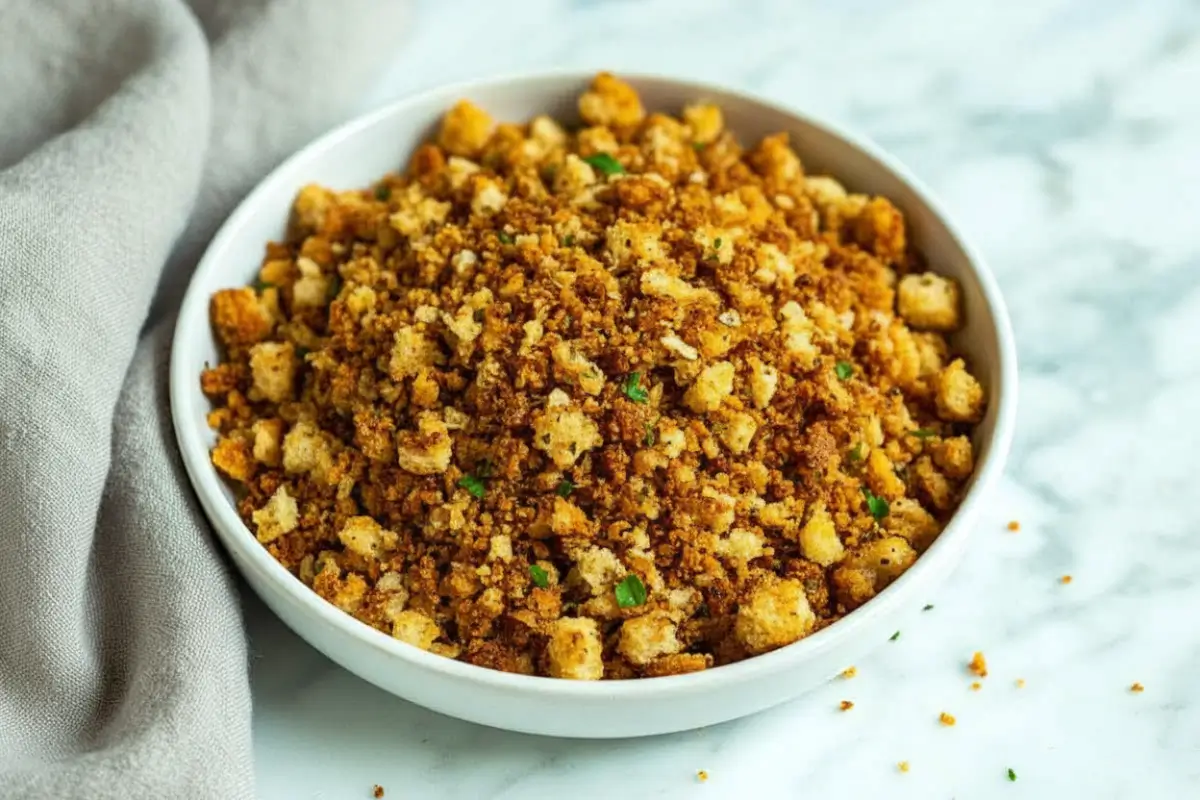
Easy No-Fail Homemade Bread Crumbs
Ingredients
Equipment
Method
- Cut the bread into small pieces.
- Pulse into breadcrumbs in a food processor.
- Toast the breadcrumbs in a skillet over medium heat.
- Alternatively, toast in the oven at 300°F.
