
You don’t need fancy equipment or a stand mixer to make bakery-quality French bread at home. This recipe proves that crusty, golden loaves are totally doable with just your hands, a bowl, and basic pantry staples. The dough comes together in minutes, and there’s zero kneading required if you use the rest-and-fold method. Your kitchen will smell like a French bakery in under an hour, and honestly? That’s the best part. Here in my Asheville kitchen, I keep this dough going on Sunday afternoons when I want fresh bread without the fuss. These easy French bread recipes for beginners skip all the intimidating steps and give you two gorgeous loaves that’ll make you look like a baking genius.
Time Breakdown: Prep: 15 mins | Cook: 30 mins | Total: 45 mins | Yields: 4 servings
Why You’ll Love This
- No mixer needed – Your hands do all the work, and it’s actually easier to feel when the dough is right
- Beginner-proof – Two rising methods so you can choose what fits your schedule
- Pantry ingredients – Nothing exotic, just flour, yeast, and oil you already have
- Bakery crust at home – That crackling golden exterior happens in any standard oven
Key Ingredients
Warm water (110-115°F) is your yeast activator. Too hot kills it, too cold leaves it sleepy. Run your tap until it feels like a comfortable bath—not scalding. No thermometer? Stick your finger in. Should feel warm but not uncomfortable.
Granulated sugar feeds the yeast and helps with browning. Just two tablespoons give the crust that gorgeous caramelized color without making the bread sweet.
Instant or active dry yeast both work here. Instant lets you skip the waiting—just dump and go. Active dry needs those 3-5 minutes to bubble and prove it’s alive. I keep instant on hand because impatient.
Salt (2 ¼ teaspoons) builds flavor and controls yeast activity. Don’t skip it or reduce it. Bread without enough salt tastes flat and weird, like you forgot something important.
Olive oil (or any neutral oil) keeps the crumb soft and adds richness. The dough stays workable and doesn’t dry out. Canola, vegetable, avocado—whatever’s open in your pantry works fine.
All-purpose or bread flour creates structure. Bread flour has more protein and gives chewier texture, but all-purpose makes excellent loaves too. Start with 5 ½ cups and add more only if the dough’s sticky. Flour amounts vary based on humidity, so trust your hands over the measuring cup.
Instructions
Mix the base. In a large bowl, combine warm water, sugar, and yeast. If using active dry, wait until it foams like beer head—that’s proof it’s working. Instant yeast? Just stir and keep going. Add salt, oil, and 3 cups of flour. Stir with a wooden spoon until shaggy and combined.
Build the dough. Gradually add 2 ½ to 3 more cups of flour, stirring between additions. The dough should pull away from the bowl sides and form a soft, slightly tacky ball. It’ll stick to your fingers a bit but shouldn’t leave globs of wet dough behind. This is where beginners panic and add too much flour—resist. Slightly sticky is perfect.
Knead briefly. Turn the dough onto a lightly floured counter. Knead for 2-3 minutes by pushing the dough away with your palm, folding it back, and rotating a quarter turn. You’re just smoothing it out, not building arm muscles. The dough should feel elastic and spring back when poked. If it clings to the counter, sprinkle a tablespoon of flour at a time until manageable.
Choose your rise. Method 1 (faster): Leave dough in the bowl, cover with a damp towel, and let rest 10 minutes. Stir it down by hand for 10 seconds—just deflate it. Repeat this rest-and-stir cycle five more times. Total time: one hour. Method 2 (traditional): Transfer dough to a greased bowl, cover, and let rise until doubled, about 60-90 minutes depending on kitchen warmth. Both methods work. I use Method 1 on busy weeknights.
Shape the loaves. Turn dough onto a lightly greased counter (not floured—you want slight traction). Divide in half. Pat each piece into a rough 9×13-inch rectangle. Starting from the long edge, roll tightly like a yoga mat, pressing out air pockets as you go. Pinch the seam closed. Place seam-side down on parchment-lined baking sheets. I use separate sheets so loaves don’t touch and get weird flat sides.
Score the tops. Using a sharp serrated knife, razor blade, or bread lame, slash 3-4 diagonal cuts across each loaf at a 45-degree angle. Cut about ½-inch deep. This lets steam escape and creates that classic French bread look. Dull knife? The dough will drag and deflate. Really sharp is non-negotiable here.
Second rise. Cover loaves loosely with greased plastic wrap or a clean towel. Let rise until puffy and nearly doubled, about 60 minutes. They should look noticeably bigger and feel airy when gently poked. Don’t skip this rise—it’s what makes the interior soft and holey.
Preheat and prep. Heat oven to 375°F with a rack in the center position. If your bread usually comes out pale, bump to 400°F or move the rack up one slot. Every oven’s different.
Create steam (optional). For bakery-level crust, toss 3-4 ice cubes onto the oven floor right after you put the loaves in. Shut the door fast. The steam keeps the crust from setting too quickly, letting the bread expand fully and develop that crackling exterior. Game changer.
Bake. Slide loaves into the oven and bake 25-30 minutes until deep golden brown. The bottoms should sound hollow when tapped. Internal temp should hit 190-200°F if you’re using a thermometer, but color’s a reliable guide.
Finish (optional). Brush hot loaves with melted butter for a softer, shinier crust. Skip this if you want maximum crunch. Let cool on a wire rack for at least 15 minutes before slicing. Hot bread gums up when cut.
Tips & Variations
Check dough texture by feel. It should be soft and slightly tacky but not wet. When you poke it, the indent should slowly spring back halfway. Too stiff? Add water one tablespoon at a time. Too sticky? Add flour sparingly.
Use the windowpane test. Stretch a small piece of dough between your fingers. If it forms a thin, translucent membrane without tearing, gluten’s developed enough. If it rips immediately, knead another minute.
Try whole wheat. Swap up to 2 cups all-purpose for whole wheat flour. Add an extra 2-3 tablespoons water since whole wheat absorbs more liquid. The loaves will be denser and nuttier.
Make garlic bread. Before the second rise, brush loaves with garlic butter (melted butter + minced garlic + parsley). Score and bake as directed. Insanely good.
Go herby. Knead in 2 tablespoons fresh rosemary or thyme after the first rise. Press some herbs into the top before scoring for a rustic look.
Storage & Pairings
Store cooled bread in a paper bag at room temperature for 2-3 days. Plastic makes the crust soggy. Freeze whole or sliced loaves in freezer bags for up to 3 months. Reheat frozen slices straight in the toaster.
Serve with olive oil and balsamic for dipping, or slice thick for bruschetta. Makes killer sandwiches—the crust holds up to wet fillings without getting mushy. Perfect alongside soups, pastas, or any meal that needs bread for sauce-sopping.
FAQ
Can I make this dough ahead?
Yes. After the first rise, punch down the dough, cover tightly, and refrigerate up to 24 hours. Let it come to room temperature (about 30 minutes) before shaping. The slow cold rise actually develops better flavor.
Why didn’t my bread rise?
Check your yeast’s expiration date—old yeast is dead yeast. Make sure your water wasn’t too hot (over 120°F kills yeast). If your kitchen’s cold, set the bowl near a warm oven or in a turned-off oven with the light on.
💡 Loved this recipe? Follow Us on Pinterest for more!
Conclusion
These easy French bread recipes for beginners prove you don’t need professional equipment to bake incredible bread. Just mix, rest, shape, and bake. The crust crackles, the inside stays soft, and your house smells amazing. Make it once and you’ll never buy store-bought French bread again.
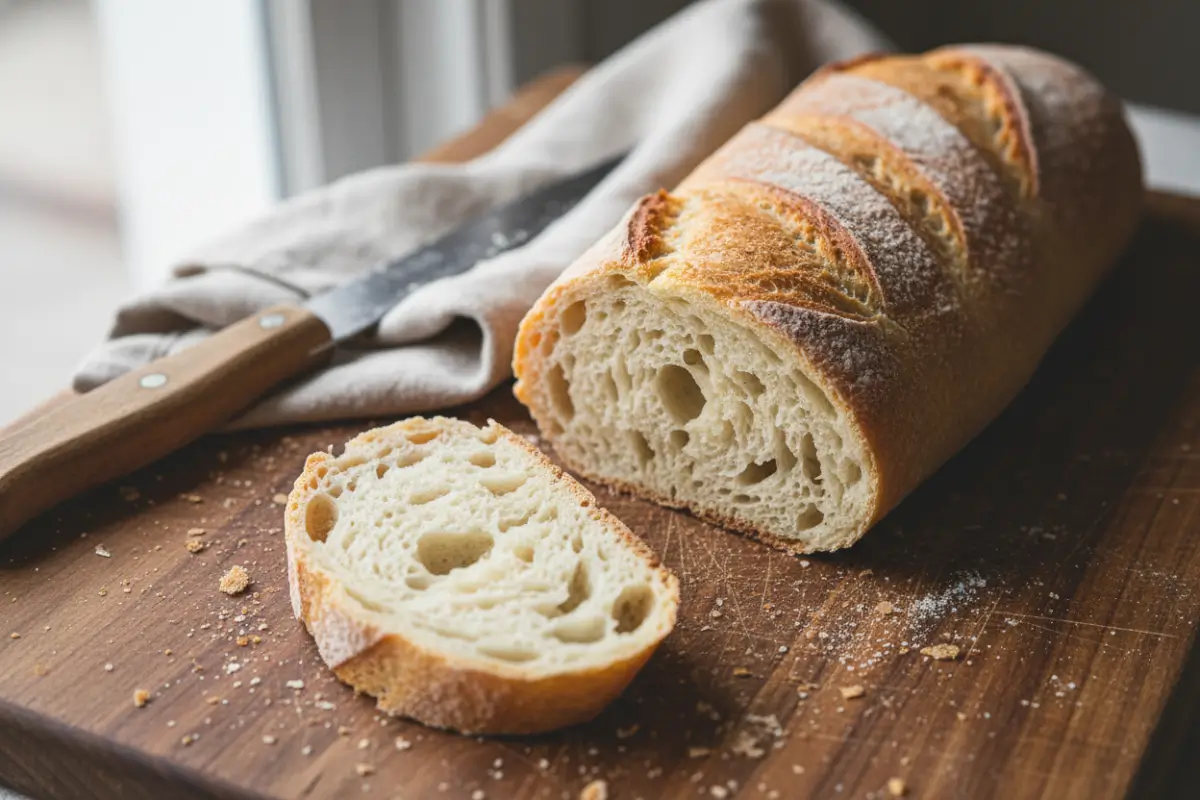
Easy French Bread Recipes For Beginners
Ingredients
Equipment
Method
- In a large bowl, combine warm water, sugar, and yeast.
- Add salt, oil, and 3 cups of flour. Stir until combined.
- Gradually add 2 ½ to 3 more cups of flour until dough forms a ball.
- Knead the dough briefly for 2-3 minutes.
- Choose your rising method: either let it rest for one hour or double in greased bowl for up to 90 minutes.
- Divide the dough in half and shape each into a rectangle, rolling tightly to form loaves.
- Score the tops of the loaves with diagonal cuts.
- Cover with plastic wrap and let rise until puffy, about 60 minutes.
- Preheat the oven to 375°F.
- Bake the loaves for 25-30 minutes until golden brown.