
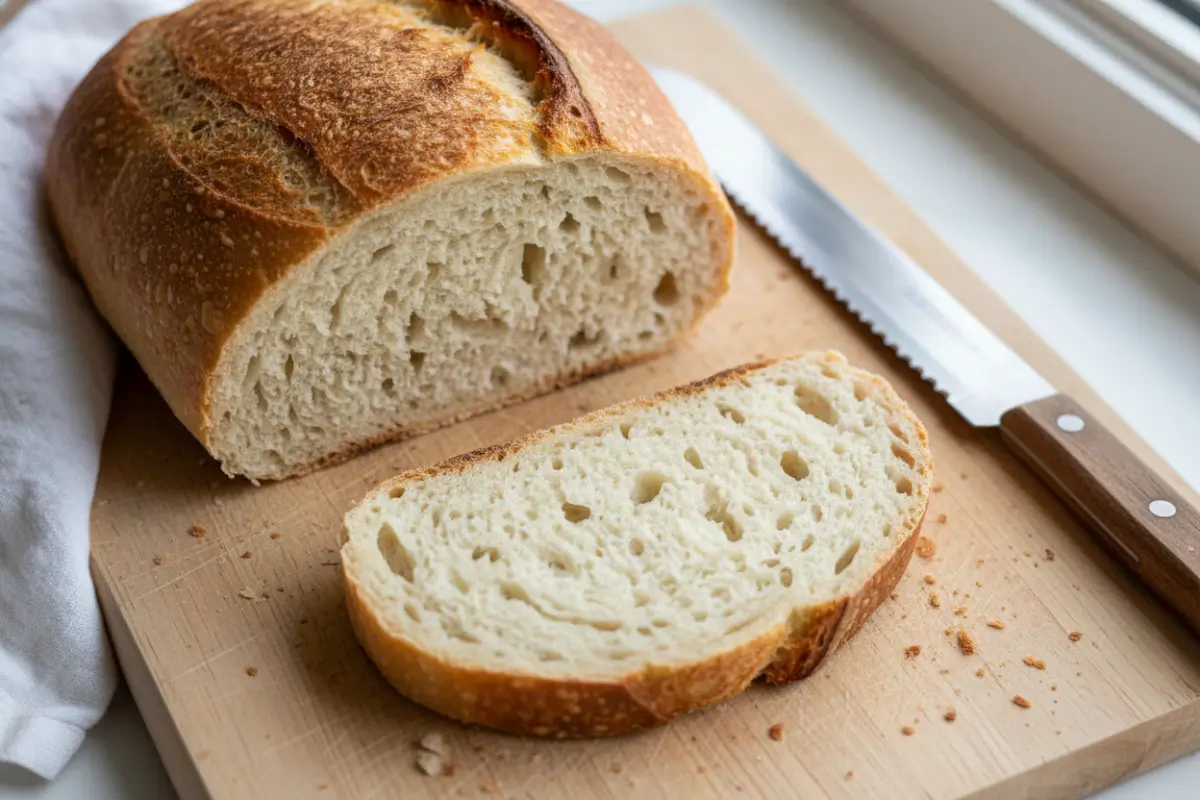
There’s something about pulling two golden loaves from the oven on a cold January evening—the crackle of crust, steam rising, that tangy-sweet smell filling every corner. This sourdough loaf with starter for cozy winter nights skips the fussy scoring and Dutch oven drama. You get tender, pillowy bread that slices clean for morning toast and holds up to thick winter stews. I’ve made this every week since November, and my kitchen counter stays dusted with flour now. Worth it.
The dough feels alive under your hands during those stretch-and-fold sessions. Active starter, warm water, simple pantry staples—that’s it. No special equipment beyond a scale and two loaf pans. The long fermentation does the heavy lifting while you sleep or work. Come morning, you’re shaping soft dough that actually cooperates instead of fighting back.
Why You’ll Love This Recipe
- Beginner-friendly sourdough that doesn’t require banneton baskets or steam setups
- Flexible timing with overnight fridge option that fits real schedules
- Soft, sandwich-ready crumb instead of artisan-only crusty boules
- Two loaves at once means one for now, one for the freezer
Key Ingredients for Tender Sourdough Loaves
Active sourdough starter (300g): This needs to be bubbly and doubled within 4-6 hours of feeding. Mine lives on my counter during winter baking season. If yours has been refrigerated, feed it twice before using—once when you pull it out, again 8-12 hours later. You want vigorous bubbles breaking the surface, not just a few lazy ones around the edges.
Warm water (650g, 105-115°F): Temperature matters here. Too hot kills the starter’s wild yeast. Too cool and fermentation crawls. I heat water in my kettle, then check with an instant-read thermometer. Asheville’s hard water works fine—no need for fancy bottled stuff.
Unbleached all-purpose flour (1000g): Bread flour makes chewier loaves; AP gives you that soft texture perfect for sandwiches. Unbleached keeps more flavor. I buy King Arthur in 10-pound bags. Bleached flour works in a pinch but tastes flatter.
Sugar or honey (50g): Feeds the yeast and adds subtle sweetness that balances sourdough tang. Honey makes slightly darker crust. Either works beautifully.
Salt (25g): Kosher or sea salt, not iodized. Controls fermentation speed and strengthens gluten structure. Don’t skip it.
Oil (40g): Avocado or olive oil keeps crumb tender for days. I use whatever’s open. The oil goes in after initial mixing—adding it early makes flour absorption harder.
How to Make Soft Sourdough Bread
Dissolve the starter: Weigh your bubbly starter, sugar, and warm water into a large bowl. Use your hand to break up the starter, swishing it through the water until mostly dissolved. Small clumps are fine. This step wakes up the yeast and distributes it evenly. Remember to tare your scale between each ingredient.
Mix the dough: Add flour and salt directly to the bowl. Use your hand like a claw, mixing in circular motions until you see mostly flour incorporated with shaggy bits. Now add the oil and keep mixing until everything comes together. The dough looks rough and uneven—that’s exactly right. Cover with oiled plastic wrap. Let rest 45 minutes at room temperature.
First stretch and fold: Wet your hand slightly. Pinch the dough’s edge, stretch it up about 8 inches, fold it over the center. Rotate the bowl a quarter turn. Repeat around the perimeter for one minute total. You’ll feel the dough tighten and strengthen. Cover again. Rest 30 minutes.
Repeat three more times: Do this stretch-fold-rest sequence three additional times (four total). Each session, the dough becomes smoother and holds its shape better. By the fourth round, it’s noticeably elastic and springs back when poked.
First fermentation: After the final fold, let dough proof until doubled. Room temperature takes about 4 hours—I see the surface dome up and tiny bubbles appear. Refrigerator proofing takes 12 hours and develops deeper flavor. I usually start dough after dinner, do the folds, then refrigerate overnight. Next morning, pull it out and let it warm up for an hour before shaping. Cold dough tears easily.
Prep your pans: Grease two 8.5×4.5-inch or 9×5-inch loaf pans generously. I use butter or cooking spray. Don’t skip corners.
Shape the loaves: Turn proofed dough onto a lightly floured counter. It should feel puffy and alive. Pinch and fold the edges toward center a few times to create surface tension. Divide dough in half with a bench scraper—eyeball it, doesn’t need to be perfect.
Take first half and gently press into a rectangle about 8 inches wide. Starting from the short end closest to you, roll tightly away from yourself like a jelly roll. Pinch the seam closed. Place seam-side down in prepared pan. Repeat with second half. The rolls should fill pans about halfway.
Second fermentation: Cover loaves with oiled plastic wrap. Let rise at room temperature until dough crowns about an inch above pan rims—1 to 4 hours depending on kitchen warmth. In my 68°F winter kitchen, this takes 3 hours. Don’t rush it. Poke the dough gently; it should spring back slowly, leaving a slight indent.
Preheat and score: Heat oven to 375°F during the last 30 minutes of rising. Remove plastic wrap. Use a sharp knife or lame to slash one long cut down each loaf’s length, about half-inch deep. This controls where the bread expands.
Bake: Slide pans onto center rack. Bake 35-40 minutes until deep golden brown. Tap the top—it should sound hollow, not thuddy. Internal temperature hits 200-205°F if you want to check.
Cool properly: Let loaves sit in pans for 10 minutes, then turn out onto a wire rack. Wait until completely cool before slicing—warm bread gums up and doesn’t slice clean. I know it’s torture. Do it anyway.
Tips and Variations
Use a scale: Volume measurements don’t work for sourdough. A scale costs $15 and eliminates guesswork. Tare between each ingredient.
Watch the dough, not the clock: Fermentation speed changes with room temperature and starter strength. Dough should double in bulk for first proof, rise one inch above pans for second. Trust your eyes.
Score confidently: One quick, decisive slash works better than tentative sawing. Really.
Whole wheat version: Replace 200g all-purpose flour with whole wheat. Add 25g extra water since whole grains absorb more. Loaves will be denser but nuttier.
Herb variation: Fold in 2 tablespoons dried rosemary and 1 tablespoon garlic powder after the second stretch and fold. Perfect with olive oil for dipping.
Storage and Serving Suggestions
Store completely cooled loaves in plastic bags at room temperature for 3-4 days. Freeze the second loaf wrapped tightly in plastic, then foil—keeps for 3 months. Thaw at room temperature for 2 hours.
Serve with salted butter and winter soups. Makes incredible French toast. Toasts beautifully even on day four when it’s slightly stale.
Frequently Asked Questions
Can I use discard instead of active starter?
No. Discard lacks the yeast strength needed for proper rise. Feed your starter 8-12 hours before mixing dough. It should double and show vigorous bubbles. Discard works for pancakes and crackers, not yeasted bread.
Why didn’t my bread rise?
Three common issues: starter wasn’t active enough, water was too hot (killed yeast), or kitchen was too cold (slowed fermentation). Next time, verify starter doubles after feeding, check water temperature with thermometer, and give dough extra time if your house runs cool.
This sourdough loaf with starter for cozy winter nights has become my cold-weather ritual. The rhythm of stretching and folding, the overnight wait, the morning shaping—it marks time differently than scrolling does. Two loaves mean you’re set for the week. One for toast, one for sharing. Start yours tonight.
Easy Sourdough Loaf With Starter for Cozy Nights
Ingredients
Equipment
Method
- Dissolve the starter: Weigh the starter, sugar, and warm water, breaking up the starter.
- Mix the dough: Add flour and salt, then mix to incorporate.
- First stretch and fold: Wet your hand and stretch the dough, then fold it over.
- Repeat stretch and folds three more times.
- Let dough proof until doubled in volume.
- Prep your pans: Grease two loaf pans.
- Shape the loaves: Turn the dough onto a floured surface, shape, and divide.
- Second fermentation: Cover and let rise until dough crowns above the pan.
- Preheat oven to 375°F.
- Bake for 35-40 minutes until golden brown.
- Cool the loaves properly before slicing.