
This is the loaf that makes you look like you’ve been baking Irish bread your whole life — crisp, golden edges, a soft and chewy crumb, and zero kneading stress required. Just four pantry staples and one cast iron skillet trick stand between you and the best homemade soda bread you’ve ever pulled from your oven.
⚡ Quick Stats: Prep: ~10 mins | Cook: 30–40 mins | Total: ~40 mins | Serves: 16 | Difficulty: Easy | Season: Spring (St. Patrick’s Day & beyond!)
From My Kitchen
Every March, I tell myself I’m going to plan ahead for St. Patrick’s Day. And every March, I’m standing in my kitchen at 4 p.m. on the 17th, realizing I have exactly zero soda bread and a family who has already started asking about dinner. Sound familiar?
That’s exactly why this Irish soda bread recipe has become my most-reached-for spring bake. It doesn’t ask much of you. No yeast, no rise time, no stand mixer humming away on the counter. You stir, you shape, you bake — and in under an hour, your kitchen smells like something magical is happening.
I’ll be honest: the first time I made this, my loaf came out a little lopsided and the score marks were barely visible. It still tasted incredible. That’s the beauty of soda bread — it’s genuinely forgiving, and a rustic shape is part of its charm. No one at your table is going to complain that it isn’t perfectly round.
Whether you’re serving it alongside a cozy bowl of soup, setting it out for a holiday gathering, or just making it because you want something homemade and warm on a Tuesday, this recipe delivers. Special without being fussy — that’s the whole idea.
Why This Recipe Works
- Smart Shortcut: Buttermilk does all the heavy lifting here — it reacts with the baking soda to leaven the bread naturally, so there’s no yeast, no proofing, and no waiting around. (And yes, you can make your own buttermilk in a pinch — more on that below.)
- Texture You’ll Love: The combination of a high oven temperature and a quick bake gives you that gorgeous golden, crisp crust with a soft, chewy interior. It’s everything you want from a homemade soda bread with raisins or caraway seeds — or just plain.
- Beginner-Friendly and Forgiving: This dough comes together with your hands in one bowl. Even if it’s a little shaggy or uneven, it bakes up beautifully. Imperfect shapes are welcome here.
- Four Ingredients, Big Flavor: Flour, salt, baking soda, buttermilk. That’s it. The simplicity is the point — and it works every single time.
The Grocery List (& Shortcuts)
Main Players
- 4 cups flour — You can use all-purpose white flour for a classic, tender crumb, or go half white and half whole wheat for a heartier, more traditional loaf. Both work beautifully. If you’re going the traditional Irish soda bread route, the whole wheat blend adds a lovely nutty depth.
- 1 teaspoon salt — Don’t skip it. Salt is what keeps this from tasting flat.
- 1 teaspoon baking soda — Fresh baking soda matters here. If yours has been sitting open in the back of the pantry since last year, grab a new box. It’s the only leavener in this bread.
- 1½ cups buttermilk — This is the secret ingredient. It reacts with the baking soda to create lift and gives the bread that subtle, slightly tangy flavor that makes it taste like a real Irish soda bread recipe traditional bakers would recognize. Add a splash more if your dough feels dry.
The Cooking Save Shortcut
Shortcut: No buttermilk in the fridge? Make your own in two minutes: add 1½ tablespoons of white vinegar or lemon juice to a measuring cup, then fill to the 1½-cup line with regular whole milk. Stir and let it sit for 5 minutes. Done. It works just as well as the real thing.
Substitutions
- Dairy-Free: Use unsweetened oat milk or almond milk with 1½ tablespoons of apple cider vinegar in place of buttermilk. The texture will be slightly different but still delicious.
- Gluten-Free: A 1:1 gluten-free all-purpose flour blend (like Bob’s Red Mill or King Arthur) can be swapped in. The dough will be stickier — that’s normal. Handle it gently.
- Want raisins? Stir in ½ to ¾ cup of raisins or currants after the flour mixture comes together. This is the classic homemade soda bread with raisins version, sometimes called “spotted dog” — and it’s wonderful with butter and tea.
- Want caraway seeds? Add 1 to 2 teaspoons of caraway seeds to the dry ingredients. This is the soda bread recipe with caraway seeds that feels most authentically Irish — earthy, slightly anise-like, and so good alongside a hearty stew.
- Out of whole wheat flour? Just use all white flour. The loaf will be a little lighter in color and texture, but just as tasty.
Equipment You Actually Need
- One large mixing bowl — That’s really it for mixing.
- A baking sheet lined with parchment paper or a silicone baking mat, generously floured. OR a cast iron skillet — this is the Irish soda bread cast iron skillet trick worth knowing. A preheated cast iron gives you an even crispier bottom crust and holds heat beautifully. If you have one, use it.
- A sharp knife or bench scraper for scoring the top of the loaf.
- A wire cooling rack — important for keeping the bottom from getting soggy while it cools.
You do not need a stand mixer, a bread machine, a Dutch oven, or any special bread-baking tools. A bowl and your hands are enough.
Step-by-Step: How to Make Irish Soda Bread
Phase 1: Prep Your Pan and Oven
- Preheat your oven to 400°F. While it heats up, line a baking sheet with parchment paper and dust it generously with flour. If you’re using a cast iron skillet, place it in the oven while it preheats — that hot surface is your secret weapon for a crispy bottom crust.
Phase 2: Mix the Dough
- Whisk the flour, salt, and baking soda together in a large mixing bowl until evenly combined. This only takes about 30 seconds — just make sure the baking soda is well distributed so you don’t get any bitter pockets.
- Pour in the buttermilk slowly while stirring with your fingers. Yes, your fingers — this is a hands-in-the-bowl kind of dough. Mix until a sticky, shaggy dough forms. If it seems dry and isn’t coming together, add a splash more buttermilk, a tablespoon at a time. You’re looking for a dough that’s tacky but holds its shape.
Phase 3: Shape and Score
- Turn the dough out onto your prepared baking sheet (or carefully onto your preheated cast iron skillet using a floured hand). Knead it gently just 4 to 5 times — this isn’t sandwich bread. Overworking it will make it tough, so keep it brief.
- Shape the dough into a disc about 6 to 7 inches across. It doesn’t need to be a perfect circle. Rustic is the whole point of a traditional Irish soda bread recipe.
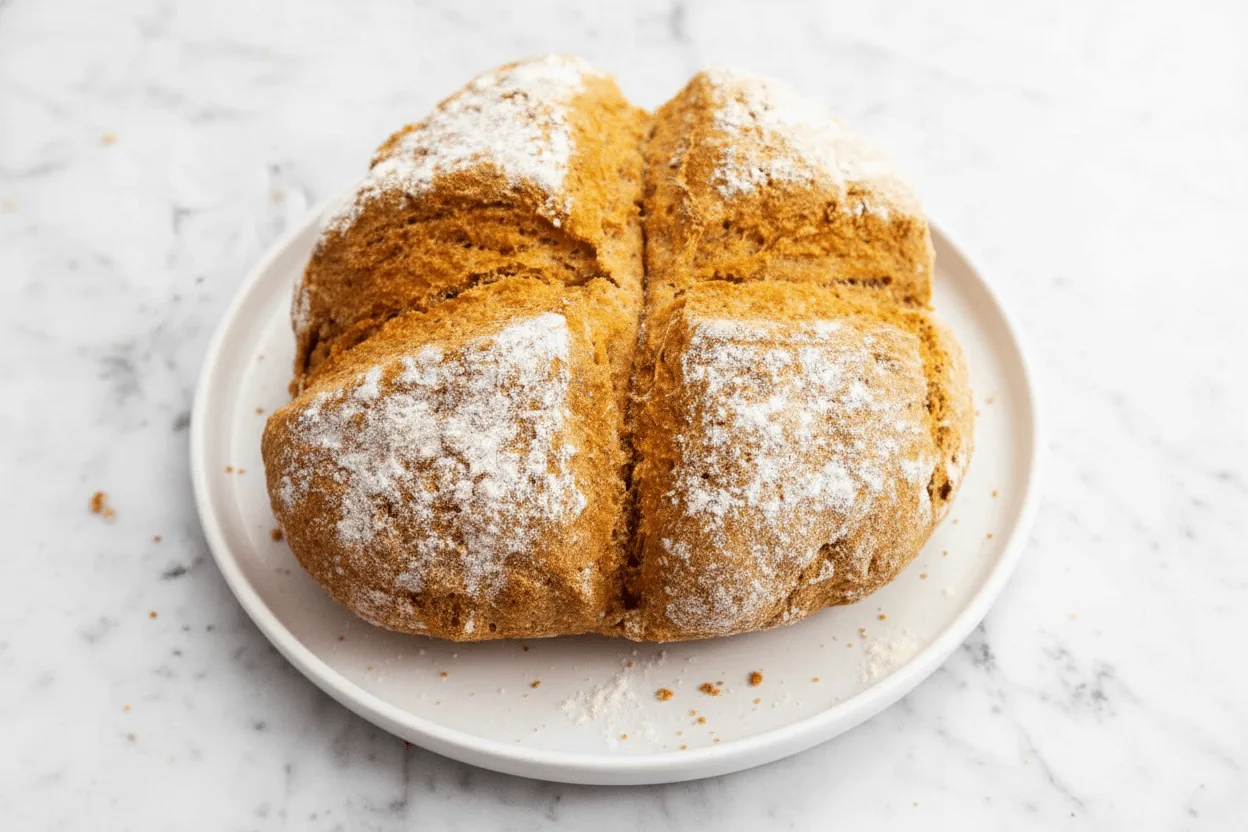
- Dust the top lightly with flour, then use a sharp knife to cut two deep incisions crosswise — all the way through, almost to the bottom. It should look like a four-leaf clover when you’re done. This isn’t just for looks: it helps the bread bake through the center and makes it easy to pull apart at the table.
Phase 4: Bake and Cool
- Bake for 30 to 40 minutes, until the top is deep golden brown and the loaf sounds hollow when you tap the bottom. That hollow thump is your sign — it means the inside is fully baked through. Start checking at 30 minutes.
- Transfer to a wire rack and let it cool for at least 10 to 15 minutes before slicing. The crumb continues to set as it cools, and cutting too early can make it gummy inside. (I know it’s hard to wait when it smells this good.)
June’s Tips for the Best Soda Bread
June’s Tip: Texture
The key to that chewy center and crisp, golden crust is a hot oven and not overworking the dough. Mix until just combined, knead only 4 to 5 times, and resist the urge to smooth it out too much. A little roughness on the surface actually helps the crust develop beautifully.
Tip: The “Oops” Fix
If your bread comes out of the oven and the center still feels a little doughy when you tap it, don’t panic — just pop it back in for another 5 to 8 minutes. If the top is browning too fast, tent it loosely with a piece of foil. Soda bread is very forgiving, and a few extra minutes in the oven won’t hurt it.
Make Ahead
Make Ahead: You can mix the dry ingredients (flour, salt, baking soda) up to a week in advance and store them in an airtight container. When you’re ready to bake, just add the buttermilk and go. This is a great little hosting shortcut — it cuts your active time down to about 10 minutes on the day.
Flavor Variations Worth Trying
- Irish Soda Bread Recipe Traditional Caraway Seeds: Add 1–2 teaspoons of caraway seeds to the dry mix. Earthy and aromatic — a classic.
- Homemade Soda Bread with Raisins: Fold in ½ cup of raisins or currants for a lightly sweet, fruit-studded loaf. Wonderful toasted with butter.
- Herb & Cheddar: Add ½ cup shredded sharp cheddar and 1 tablespoon fresh rosemary to the dough. Incredible alongside soup.
- Citrus Twist: Add the zest of one orange to the dough for a bright, unexpected note that pairs beautifully with the tangy buttermilk.
What to Serve With This
For a Cozy Weeknight Dinner
Pair this loaf with a big pot of creamy potato soup or a hearty beef and vegetable stew. Tear off a warm chunk, swipe it through the broth, and call it the best Tuesday you’ve had in a while. A mug of Irish breakfast tea or a cold Guinness on the side doesn’t hurt either.
For a St. Patrick’s Day Spread
Serve it sliced alongside corned beef and cabbage, with a generous dish of good salted butter on the table. It also makes a lovely addition to a holiday brunch board — slice it thick and set it out with jam, honey, and soft cheese.
For a Party or Gathering
Bake two loaves (this recipe doubles easily), slice them into wedges, and set them out as a bread basket. It’s the kind of thing that disappears fast and gets everyone asking for the recipe — which you can happily share.
Storage & Leftovers
- Counter: Wrap the cooled loaf in a clean kitchen towel or store in a bread bag at room temperature. It’s best within 1 to 2 days — soda bread doesn’t have preservatives, so it goes stale faster than yeasted bread.
- Fridge: You can refrigerate it for up to 3 to 4 days, though the texture is best at room temperature or lightly toasted.
- Reheating: Slice and toast individual pieces in a toaster or warm the whole loaf in a 300°F oven for about 10 minutes. It brings the crust right back to life.
- Freezer: Yes! Soda bread freezes really well. Wrap the fully cooled loaf tightly in plastic wrap, then in foil or a zip-top freezer bag. Freeze for up to 2 months. Thaw at room temperature overnight, then warm in the oven before serving. You can also freeze individual slices for easy grab-and-toast mornings.
Frequently Asked Questions
Can I bake Irish soda bread in a cast iron skillet instead of on a baking sheet?
Absolutely — and honestly, I’d encourage it. Preheating a cast iron skillet in the oven before adding the dough gives you a crispier, more evenly browned bottom crust. It’s one of the best Irish soda bread tips I can offer. Just be careful when placing the shaped dough into the hot skillet — use a floured hand and work quickly.
Why do you score the top of soda bread?
Those deep cuts aren’t just decorative. They help the heat reach the center of the loaf, ensuring it bakes through evenly. Cut all the way through — almost to the bottom — so the bread can open up as it bakes. The four-leaf clover shape is traditional, and it also makes the loaf easy to pull apart into wedges at the table.
Can I double this recipe for a crowd?
Yes! This recipe doubles easily. Just make two separate loaves rather than one giant one — a very large loaf can be tricky to bake through evenly. Two smaller loaves also means one for now and one for the freezer, which is always a good plan.
My soda bread turned out dense. What happened?
A dense loaf usually means one of two things: the baking soda wasn’t fresh (test it by dropping a pinch in hot water — it should fizz immediately), or the dough was overworked. Remember, just 4 to 5 gentle kneads is all it needs. Treat it like a scone dough, not a pizza dough.
Can I make this gluten-free?
Yes! Swap in a 1:1 gluten-free all-purpose flour blend. The dough will be stickier and a little harder to shape, but it bakes up nicely. Wet your hands slightly to help with shaping, and don’t worry if it looks a little rough — it’ll still taste great.
Is this the same as traditional Irish soda bread?
This is about as close to an Irish soda bread recipe traditional home bakers would recognize as you can get — four simple ingredients, no yeast, shaped by hand, and scored with a cross. Some traditional versions include caraway seeds or raisins (or both!), but the base recipe is exactly this simple.
💡For more recipes, follow me on Pinterest.
Try It and Tell Me How It Goes
If you make this Irish soda bread, I’d love to hear about it. Drop a comment below and let me know how it turned out — did you go classic, or did you add raisins or caraway seeds? Did you try the cast iron skillet trick? Save this recipe for later so you always have it handy when the craving (or the holiday) hits, and come back any time you need an easy, reliable bake that makes the whole house smell like something wonderful is happening.
With something sweet,
June 🎄
Super Simple Irish Soda Bread
Ingredients
Equipment
Method
- Preheat oven to 400°F and prepare baking sheet with parchment paper and flour.
- Whisk flour, salt, and baking soda in a bowl.
- Pour in buttermilk while stirring with fingers until a sticky dough forms.
- Turn dough onto prepared surface, knead gently a few times, and shape into a disc.
- Dust the top with flour and cut two deep incisions crosswise.
- Bake for 30 to 40 minutes until golden brown and sounds hollow when tapped.
- Transfer to a cooling rack and let cool before slicing.
